Published:
AS EN 301 549 has rapidly become the default accessibility standard for ICT procurement across Australia. As government agencies modernise their procurement frameworks, suppliers are expected to demonstrate conformance — not just to WCAG, but to the broader requirements of EN 301 549. For vendors and procurement teams alike, understanding this shift is essential.
The Standard That’s Reshaping ICT Procurement
Don’t get me wrong… WCAG is still critical for web, and more broadly digital accessibility. But when it comes to government procurement of ICT products and services, AS EN 301 549 has emerged as the comprehensive standard that buyers are now expecting suppliers to meet. This article explores why this shift is happening and what it means for vendors and procurement teams in 2026.
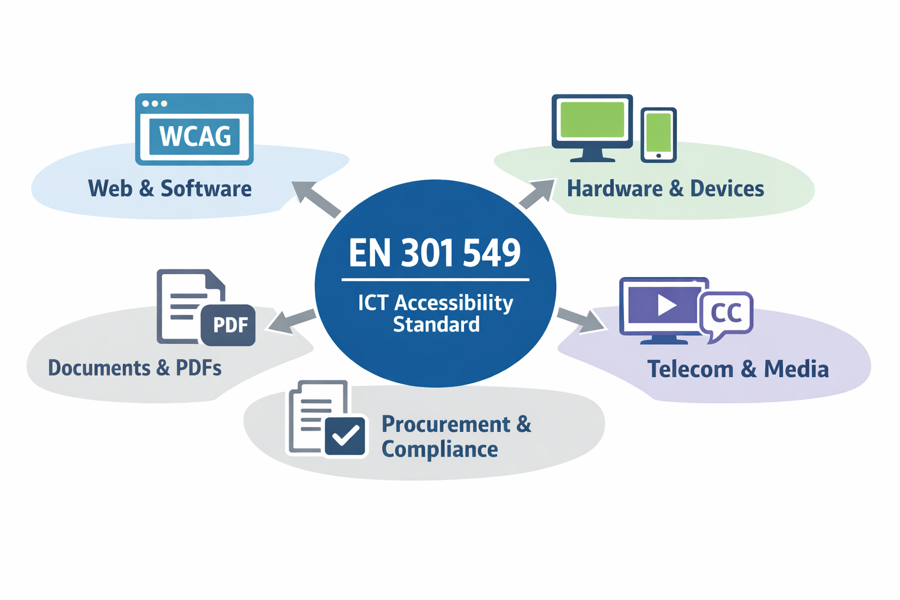
Note: EN 301 549 (PDF) is the European standard for ICT accessibility, which has been adopted in full by the Australian government as the baseline for procurement as AS EN 301 549. It covers a wide range of technologies and is more comprehensive than WCAG alone. For simplicity I will refer to it as EN 301 549 in this article, but it’s important to note that in the Australian context it is formally adopted as AS EN 301 549.
What AS EN 301 549 Covers
Unlike WCAG, which focuses on web content, EN 301 549 covers:
- We
- Software
- Mobile apps
- Documents
- Hardware
- Telecoms
- Biometrics
- Authentication
- Functional performance criteria
It is a whole of ICT standard. This means that government buyers can now require suppliers to demonstrate conformance across all these areas, not just web accessibility. For vendors, this means that meeting WCAG is necessary but not sufficient for much government procurement.
Why Governments Are Standardising on EN 301 549
1. Consistency
Agencies want a unified approach across all procurement categories. They want a Standard to capture Requirements for SaaS products, hardware, documents and more in addition to websites. EN 301 549 provides that consistency.
2. What happens to WCAG?
WCAG is still the standard for web content, but EN 301 549 references it as part of its requirements as ‘9. Web’. So for web procurement, WCAG compliance is still expected, but now it’s part of a broader set of accessibility requirements under EN 301 549.
3. Clarity
EN 301 549 provides detailed requirements for non-web technologies too. For example ‘8. Hardware’ and ‘10. Non-Web Documents’. This gives buyers clearer criteria for evaluating accessibility across a wider range of products and services.
4. Global alignment
Many international jurisdictions already use EN 301 549, so adopting it in Australia aligns with global best practices and facilitates international trade.
5. Reduced ambiguity
WCAG alone is not sufficient for complex ICT procurement. For example, WCAG doesn’t cover hardware accessibility or functional performance criteria. Imagine a digital kiosk in a bank or shopping centre, for instance. EN 301 549 supplements digital use with physical access requirements such as forward or side reach so people with mobility impairments can use them too.
What Government Buyers Expect From Vendors in 2026
1. ACRs aligned to EN 301 549
Not just WCAG. Not just marketing claims.
2. Evidence of testing
Buyers expect vendors to provide evidence of testing against EN 301 549 requirements, including manual testing, assistive technology testing and documented methods.
3. Accessibility roadmaps
Buyers don’t expect perfection. They do expect honesty and clarity. If gaps exist, vendors must show how and when they will be addressed. This is especially important for products that are still evolving, such as SaaS platforms. Buyers want to see a clear roadmap for how accessibility will be improved over time, with specific milestones and timelines.
4. Governance
Buyers want to see accessibility owners, processes and continuous monitoring in place to ensure ongoing compliance with EN 301 549 as products evolve.
How Procurement Teams Should Adapt
1. Update procurement templates
Help your buyers choose accessible products by including EN 301 549 references and requirements in procurement templates.
2. Train staff
Procurement officers need to understand the standard at a practical level.
3. Build accessibility checkpoints into evaluation
Accessibility should be assessed at:
- RFP stage - require EN 301 549 conformance claims and evidence such as ACRs and testing reports.
- Evaluation stage - read and understand the accessibility claims and evidence provided by vendors, and require accessible use in demonstrations. This may require training or support from accessibility experts.
- Contract negotiation - include accessibility requirements and remediation obligations in contracts, with clear consequences for non-compliance.
- Implementation - monitor accessibility during implementation and require regular updates on progress against any remediation roadmaps. This may need ongoing engagement with vendors or implemnentation partners to ensure they are meeting their commitments.
- Documentation and Training - Are instruction guides, videos or other training part of the package? Make sure your users with disabilities are not left behind by ensuring that accessibility extends to all user-facing materials and support.
- Ongoing monitoring - establish processes for monitoring accessibility post-contract, including regular reviews of vendor performance against EN 301 549 requirements and roadmaps.
4. Require updated ACRs annually
Accessibility changes as products evolve. Today’s accessible SaaS platform may not be tomorrow’s. Require vendors to provide updated ACRs annually to ensure ongoing compliance with EN 301 549 as products evolve.
Future Trends
As accessibility becomes more embedded in procurement, we can expect to see mandatory reporting, integration with cybersecurity assurance, increased scrutiny of vendor claims and more mature accessibility governance across government.
Conclusion
AS EN 301 549 is now the baseline for ICT procurement in Australia. Vendors who understand and align with it will win more tenders. Procurement teams who enforce it will make this transition easier for their buyers, reduce risk and improve outcomes.
Handy Tools & Resources
Services
- Products you buy: Get the support and guidance you need to design and build better digital experiences that everyone can use.